
The Safest Day Is the One Nobody Notices
Aug 29, 2026
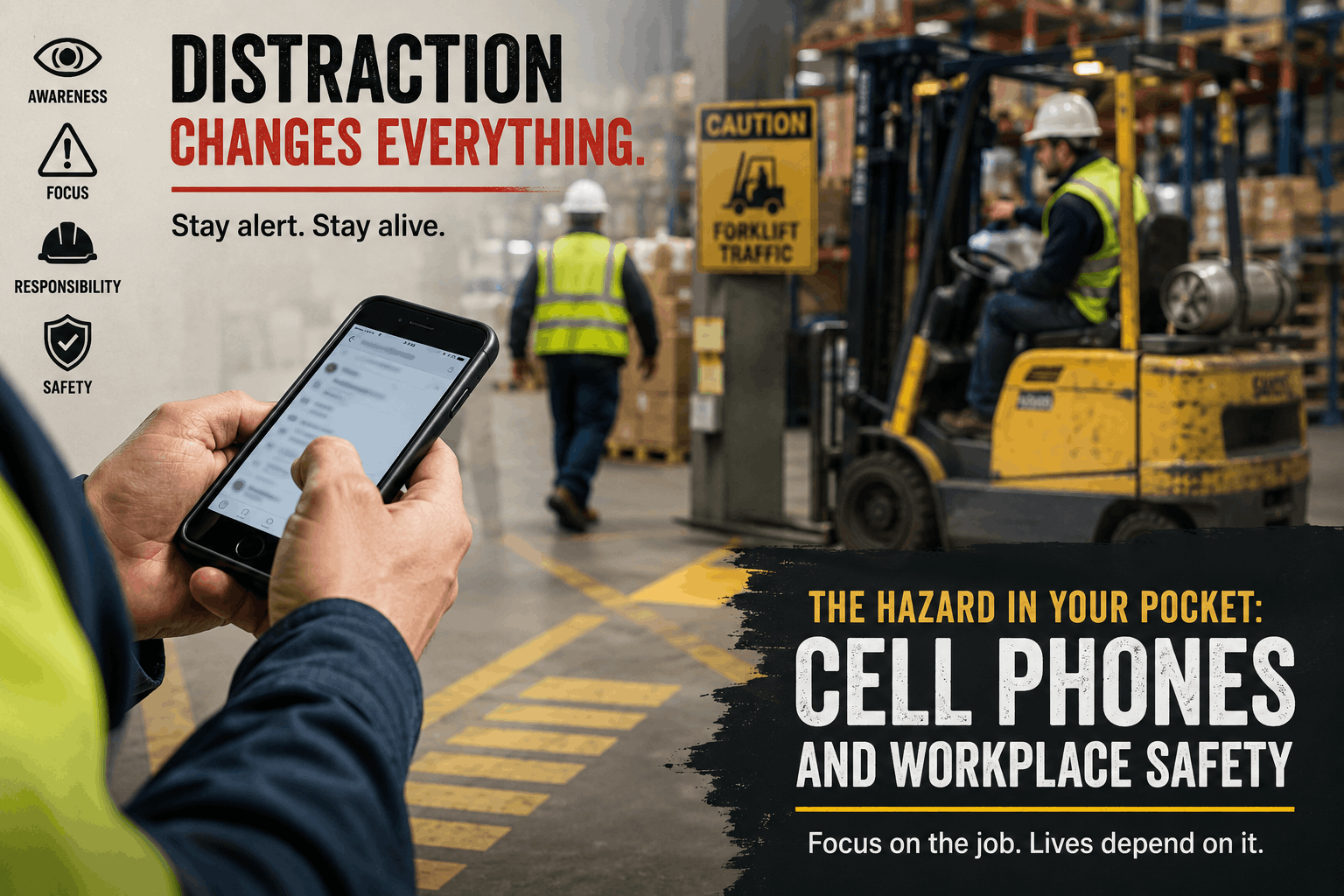
Walk through almost any workplace today and you will see them.
Employees checking messages. Supervisors answering emails. Someone walking down a
hallway while looking at a screen. A worker taking a picture of a job in progress. Another
employee checking a notification while moving from one task to another.
The cell phone has become so normal that we barely notice it anymore.
Maybe that is part of the problem.
The Cell Phone Isn't the Problem
I don't think the answer is banning cell phones from every workplace.
In many cases, they have become valuable workplace tools. We use them for communication, photographs, inspections, documentation, emergency notifications, training, accessing procedures, and dozens of other legitimate purposes.
The problem begins when using the phone takes attention away from the environment around us.
Think about something as simple as walking while reading a text message.
In an office, that distraction might result in someone walking into another person or tripping over something.
Now move the same behavior into a warehouse.
Add forklifts, pallet jacks, and moving equipment.
Move it onto a construction site and add uneven walking surfaces, vehicles, open excavations, and overhead work.
Move it into a hospital and add patient movement, medical equipment, carts, and busy corridors.
The phone didn't change.
The consequences of the distraction did.
We Talk About Distracted Driving. What About Distracted Working?
Most people understand the danger of texting while driving.
The concept is simple. Your eyes, hands, and attention need to be focused on operating the vehicle.
Yet we sometimes treat distraction differently once someone steps out of the vehicle and walks into the workplace.
A notification comes in.
We instinctively look.
An email arrives from a supervisor.
We answer it.
Someone sends a text.
We read it while walking.
These actions may only take a few seconds, but workplace incidents can also develop in a few seconds.
The problem becomes even more complicated when employees believe they are expected to respond immediately.
If a supervisor regularly sends messages and expects instant responses, employees may begin checking their phones during activities where their attention should be somewhere else.
At that point, cell phone distraction isn't only an employee behavior issue.
It can become a leadership issue.
Distraction Is More Than Looking at the Screen
Cell phone distractions can happen in several ways.
Visual distraction occurs when we take our eyes away from the work environment to look at the phone.
Manual distraction occurs when we take a hand away from the task to hold, type, or interact with the device.
Cognitive distraction may be the easiest one to overlook.
You can put the phone back in your pocket and still be thinking about the message you just received.
That's especially important in jobs requiring situational awareness, decision-making, equipment operation, or hazard recognition.
Being physically present at the job does not necessarily mean your attention is there.
There Is Another Side to This
Cell phones can also improve safety.
An employee can photograph a hazard immediately.
A supervisor can quickly communicate an unsafe condition.
Workers can receive emergency notifications.
Safety professionals can document inspections, access information, and communicate across large facilities.
An employee may even be able to call for emergency assistance faster because the phone is already in their pocket.
So I don't believe the question should be:
"Should employees be allowed to have cell phones?"
A better question may be:
"When and where is cell phone use appropriate?"
That is a much more useful safety conversation.
Establish the Boundary Before the Incident
Organizations should identify activities and locations where cell phone use creates an unacceptable distraction.
That could include:
But a policy alone isn't enough.
Employees also need to understand why the restriction exists.
And leadership has to follow the same expectations.
It is difficult to tell an employee not to look at a phone while walking through an operational area if supervisors routinely do exactly that.
Safety expectations become much stronger when the behavior is demonstrated from the top down.
Try This Tomorrow
The next time you walk through your workplace, don't just look for traditional hazards.
Look at attention.
Ask yourself:
And perhaps the most important question:
Have we become so accustomed to cell phones that we stopped recognizing distraction as a hazard?
Technology isn't leaving the workplace.
If anything, our dependence on mobile devices will continue to increase.
The goal shouldn't be eliminating technology.
The goal should be to make sure that when the environment requires our attention, the workplace gets our attention first.


Comments (0)
No comments yet. Be the first to comment!
Leave a Comment