
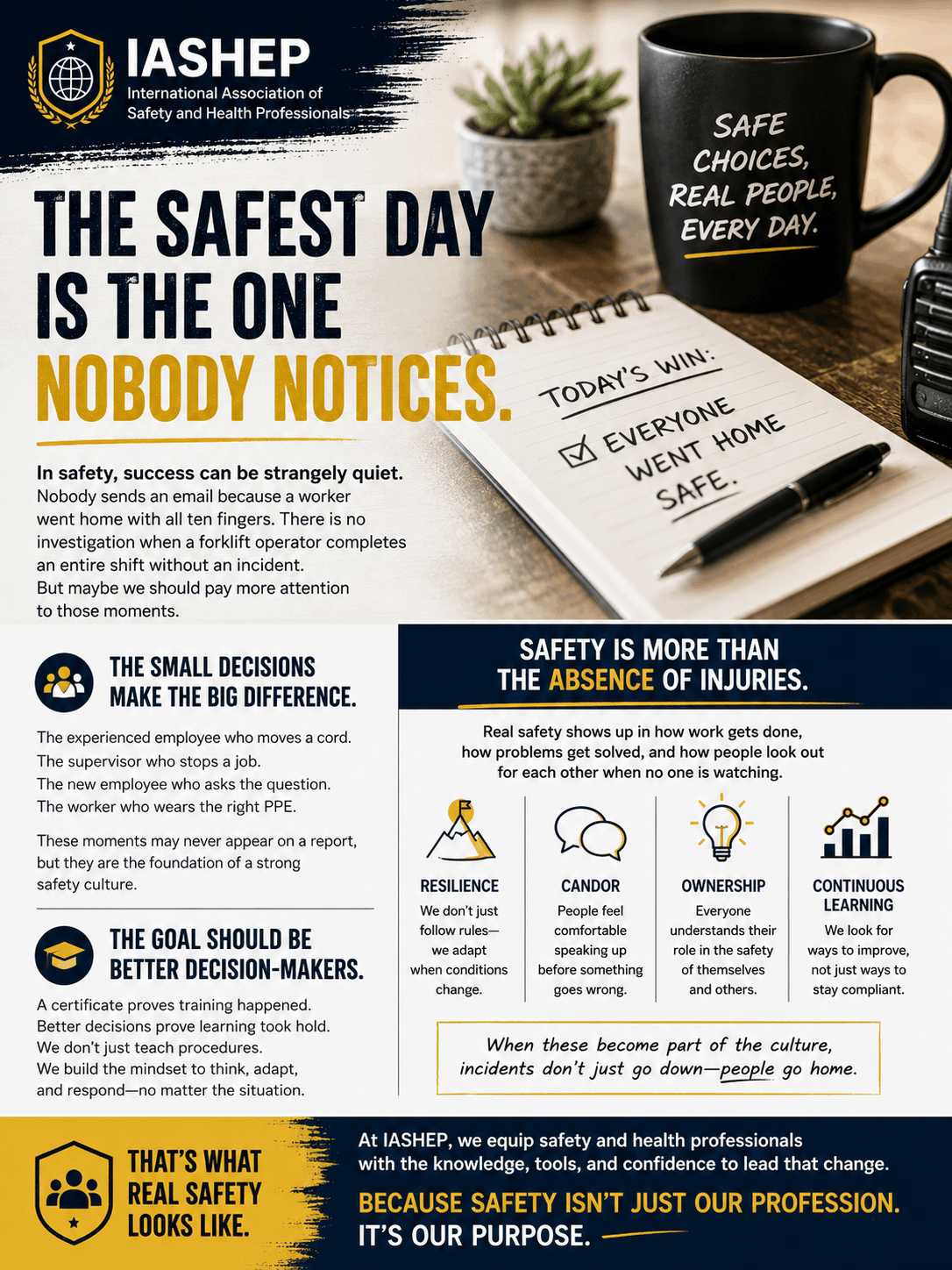
The Safest Day Is the One Nobody Notices
Aug 29, 2026

The safety profession never stands still—and neither should the professionals responsible for protecting workers. Every month brings new enforcement actions, emerging workplace hazards, technological advancements, and valuable lessons learned from incidents across the country. Staying informed is no longer simply about maintaining compliance; it is about recognizing risks early, adapting to change, and preventing injuries before they occur.
As workplaces evolve through automation, artificial intelligence, and changing regulatory expectations, safety professionals must continuously update their knowledge and strengthen their ability to respond to new challenges. Organizations that invest in proactive safety programs, employee engagement, and ongoing professional development are better positioned to reduce incidents while improving productivity and operational performance.
Below are some of the most important workplace safety topics safety professionals should be paying close attention to this month.
OSHA Continues Focusing on High-Risk Hazards
The Occupational Safety and Health Administration (OSHA) continues to prioritize hazards that consistently lead to serious injuries and workplace fatalities. Recent enforcement activity highlights the agency's continued focus on preventing incidents involving falls, excavation work, confined spaces, lockout/tagout procedures, machine guarding, and other high-risk operations. OSHA's August 2026 communications also continue emphasizing heat illness prevention and workplace outreach as key priorities.
For employers, these enforcement efforts reinforce an important message: compliance should never be viewed as the finish line. While meeting OSHA requirements is essential, organizations achieve the greatest success when safety becomes part of everyday decision-making rather than something addressed only during inspections.
Safety professionals should use these reminders as an opportunity to evaluate their existing programs by asking questions such as:
Regular audits, effective communication, and employee involvement remain among the strongest tools organizations have for preventing serious incidents before they occur.
Heat Illness Prevention Remains a National Priority
As high temperatures continue across many parts of the United States, protecting employees from heat-related illnesses remains one of the most important responsibilities for employers. OSHA continues to promote awareness of heat illness prevention through education, outreach, and enforcement activities, reminding employers to recognize warning signs and implement preventive measures before emergencies occur.
Industries facing elevated heat exposure include:
Construction
Manufacturing
Warehousing
Agriculture
Landscaping
Transportation
Utilities
Oil and gas operations
Heat-related illnesses remain among the most preventable workplace hazards, yet they continue to affect thousands of workers every year.
Employers should continue emphasizing:
Providing cool drinking water throughout the workday
Early warning signs such as heavy sweating, dizziness, fatigue, nausea, muscle cramps, headaches, or confusion should never be ignored. Prompt action can prevent heat exhaustion from progressing into life-threatening heat stroke.
Organizations that prepare employees before temperatures become dangerous are far more likely to prevent medical emergencies than those that respond only after symptoms appear. A comprehensive heat illness prevention program not only protects workers but also helps reduce absenteeism, equipment downtime, and costly operational disruptions.
Technology Is Transforming Workplace Safety
Technology continues to reshape nearly every aspect of occupational safety and health.
Artificial intelligence, predictive analytics, wearable devices, connected sensors, drones, and digital inspection tools are helping organizations identify hazards faster than ever before.
Rather than relying solely on historical incident reports, many organizations are beginning to analyze workplace data to identify patterns that may predict future risks.
Examples include:
Wearable technology is also becoming increasingly valuable. Smart devices can monitor environmental conditions, worker movement, body temperature, fatigue indicators, and exposure to hazardous conditions in real time. This allows organizations to intervene before an incident occurs instead of reacting afterward.
Digital inspection software has also simplified many routine safety processes by replacing paper forms with cloud-based documentation that improves accountability, reporting accuracy, and communication across multiple worksites.
Artificial Intelligence Supports Better Decision-Making
Artificial intelligence continues to gain attention within the occupational safety profession—not as a replacement for experienced safety professionals, but as a tool that can improve efficiency and decision-making.
Support risk assessments
These capabilities allow safety teams to spend less time managing paperwork and more time addressing workplace hazards.
However, technology should never replace professional judgment.
Artificial intelligence can process large amounts of information quickly, but it cannot replace experience, leadership, critical thinking, or the ability to evaluate unique workplace conditions.
The most successful organizations combine technological innovation with knowledgeable safety professionals who understand both regulatory requirements and the practical realities of day-to-day operations.
Building a Stronger Safety Culture
Compliance is an essential part of workplace safety, but compliance alone does not automatically create a safe workplace. Organizations that experience the greatest success often go beyond minimum regulatory requirements by building a culture in which safety is treated as a shared responsibility.
A strong safety culture develops through thousands of everyday decisions rather than through an annual training event or an occasional regulatory inspection. It is reflected in how supervisors respond when an employee reports a hazard, how management prioritizes corrective actions, and whether employees feel comfortable speaking up when something does not look safe.
Employees who are encouraged to report hazards and near misses can help organizations identify problems before they result in injuries. Supervisors who consistently lead by example demonstrate that safety expectations apply to everyone. Leadership teams that provide adequate resources and actively participate in safety initiatives show employees that workplace safety is a genuine organizational priority.
Safety culture is not a program that can simply be implemented and checked off a list. It is the collective commitment of everyone within an organization.
The Importance of Employee Engagement
A successful safety program depends on more than policies and procedures. Employees who perform the work every day often have valuable knowledge about the hazards associated with specific tasks.
Encouraging workers to participate in safety discussions can help organizations identify risks that may otherwise be overlooked. Employees can provide insight into equipment problems, workflow challenges, repetitive tasks, near misses, and other conditions that may not be immediately visible during a formal inspection.
Organizations can strengthen employee engagement by:
Encouraging employees to report hazards and near misses
Listening to employee concerns without retaliation
Including workers in safety discussions
Recognizing positive safety behaviors
Providing opportunities for employees to suggest improvements
Communicating corrective actions after hazards are reported
When employees understand that their observations are valued and acted upon, they are more likely to participate actively in workplace safety.
Why Professional Development Matters
The safety profession continues to evolve as industries adopt new technologies, regulations change, and workplace risks become increasingly complex. Continuous professional development helps safety professionals remain prepared to address these challenges while providing greater value to their organizations.
Professional certifications, continuing education, networking opportunities, and the exchange of knowledge between experienced practitioners all contribute to stronger safety programs and better outcomes for workers.
Professional development can also help safety professionals strengthen skills that go beyond technical knowledge. Effective communication, leadership, risk assessment, problem-solving, and decision-making are all important components of successful safety management.
A professional who continues learning is better positioned to recognize emerging hazards, understand changes affecting the industry, and help organizations respond before problems become serious incidents.
Investing in professional growth is ultimately an investment in safer workplaces.
Staying Current With Changing Safety Requirements
Workplace safety professionals cannot rely solely on the information they learned when they first entered the profession. Regulations, standards, technology, and industry practices can change over time.
For example, OSHA continues to update its programs and guidance as workplace risks evolve. Its current regulatory agenda includes ongoing rulemaking related to areas such as heat injury and illness prevention, emergency response, tree care operations, and other workplace safety topics.
Heat safety is another example of why staying informed matters. OSHA updated its National Emphasis Program for indoor and outdoor heat-related hazards in April 2026, directing inspection and outreach resources toward industries and workplaces where heat stress risks are most significant.
These developments demonstrate why safety professionals should regularly review current requirements and industry guidance rather than assuming that previous knowledge will always remain sufficient.
Turning Knowledge Into Action
The true value of professional development is demonstrated through application.
A safety professional may understand a regulation, but the more important question is whether that knowledge can be applied effectively when a real workplace problem occurs.
Can the professional recognize a developing hazard?
Can they evaluate the level of risk?
Can they recommend practical controls?
Can they explain the issue clearly to employees and leadership?
Can they respond effectively when production pressures conflict with safety requirements?
These situations require more than memorized information. They require judgment, communication, experience, and the confidence to make responsible decisions.
Continuous learning provides professionals with opportunities to strengthen those abilities and apply them to increasingly complex workplace situations.
Practical Steps Safety Professionals Can Take This Month
Staying informed does not always require a major change to an organization's safety program. Small, consistent actions can make a meaningful difference.
Safety professionals can use this month as an opportunity to:
Review recent incidents and near misses. Look for recurring patterns or hazards that may require additional controls.
Revisit employee training. Confirm that training addresses the actual hazards workers encounter rather than relying solely on generic material.
Review high-risk activities. Pay particular attention to falls, machine guarding, lockout/tagout, confined spaces, excavation, material handling, and heat exposure.
Evaluate emergency procedures. Make sure employees understand what to do when an incident or medical emergency occurs.
Talk with employees. Ask workers what hazards they are seeing and what safety improvements they believe would make their jobs safer.
Review current regulatory developments. Staying aware of OSHA updates and industry changes can help organizations prepare before new requirements or risks affect operations.
Invest in professional development. Identify areas where additional education or certification could strengthen the organization's safety capabilities.
These steps can help turn an industry update into meaningful action rather than simply information that is read and forgotten.
IASHEP's Commitment to the Profession
At IASHEP, we believe knowledge should be shared, experience should be valued, and professional growth should never stop.
Our commitment is to provide practical information, trusted education, and a professional community dedicated to advancing occupational safety and health across every industry. By fostering collaboration, encouraging continuous learning, and promoting excellence in the profession, we strive to equip safety professionals with the knowledge and resources they need to make a lasting impact.
Professional development is not simply about adding another credential to a résumé. It is about developing the knowledge, judgment, and confidence necessary to make better decisions when workplace safety is at stake.
Whether professionals are beginning their careers, expanding their responsibilities, or continuing to build on years of experience, ongoing education can help them remain prepared for the challenges ahead.
Together, we can help build safer workplaces—one informed decision at a time.
Safety Is a Commitment
Safety is more than a profession—it is a commitment to protecting lives.
Every inspection completed, hazard reported, corrective action taken, employee trained, and unsafe condition addressed can contribute to preventing an incident.
The most effective safety professionals understand that their responsibility does not end when a training course is completed or a certification is earned. They continue learning, asking questions, examining new technologies, studying industry developments, and sharing knowledge with others.
That commitment becomes particularly important as workplaces become more complex.
New technologies can create new hazards. Changing regulations can create new responsibilities. Employees may face risks that did not exist when an organization's safety program was originally developed.
The organizations that are best prepared for these changes are those that treat safety as an ongoing process.
IASHEP is proud to support that commitment by helping safety professionals grow, connect, and lead with confidence.
Frequently Asked Questions About Workplace Safety Trends
What are some of the most important workplace safety concerns in 2026?
Workplace safety professionals should continue paying attention to high-risk hazards such as falls, machine guarding, lockout/tagout, confined spaces, excavation, material handling, and heat exposure. Emerging technologies and changing workplace practices also require organizations to continually evaluate new risks.
Why is heat illness prevention important for employers?
Heat exposure can lead to serious illness and can become life-threatening when workers are not properly protected. OSHA recommends prevention measures such as water, rest, shade, acclimatization, training, monitoring, and appropriate controls for workers exposed to hazardous heat.
How is artificial intelligence being used in workplace safety?
Organizations are exploring AI for tasks such as analyzing incident data, identifying trends, supporting inspections, improving documentation, and helping prioritize potential hazards. However, AI should support rather than replace the professional judgment of qualified safety personnel.
What is a strong safety culture?
A strong safety culture exists when safety is treated as a shared responsibility throughout an organization. Leadership demonstrates commitment, supervisors lead by example, and employees feel comfortable reporting hazards and participating in safety improvements.
Why is continuing education important for safety professionals?
Continuing education helps safety professionals keep their knowledge current as regulations, technology, workplace hazards, and industry practices change. It also strengthens professional judgment and the ability to apply safety knowledge in real workplace situations.
How can employers improve workplace safety?
Employers can improve workplace safety by identifying hazards proactively, providing relevant training, involving employees in safety decisions, investigating incidents and near misses, maintaining equipment, monitoring changing risks, and providing adequate resources for corrective actions.
Final Thoughts
The safety profession continues to change, and staying informed is one of the most important responsibilities of anyone working in occupational safety and health.
From OSHA enforcement and heat illness prevention to artificial intelligence and employee engagement, today's safety professionals have more tools and information available than ever before. The challenge is turning that information into practical action.
Organizations should not wait for an injury, inspection, or regulatory citation to identify weaknesses in their safety programs. Proactive inspections, employee involvement, continuous education, and strong leadership can help identify and address hazards before they result in harm.
Professional development is an important part of that process. When safety professionals continue learning, organizations benefit from stronger knowledge, better decision-making, and greater preparedness for emerging challenges.
At IASHEP, we believe that advancing workplace safety requires a commitment to knowledge, collaboration, and continuous improvement.
Join IASHEP today and become part of a global community dedicated to advancing workplace safety and health.
Visit IASHEP to learn more about professional certifications, professional development opportunities, and membership benefits.
Comments (0)
No comments yet. Be the first to comment!
Leave a Comment