
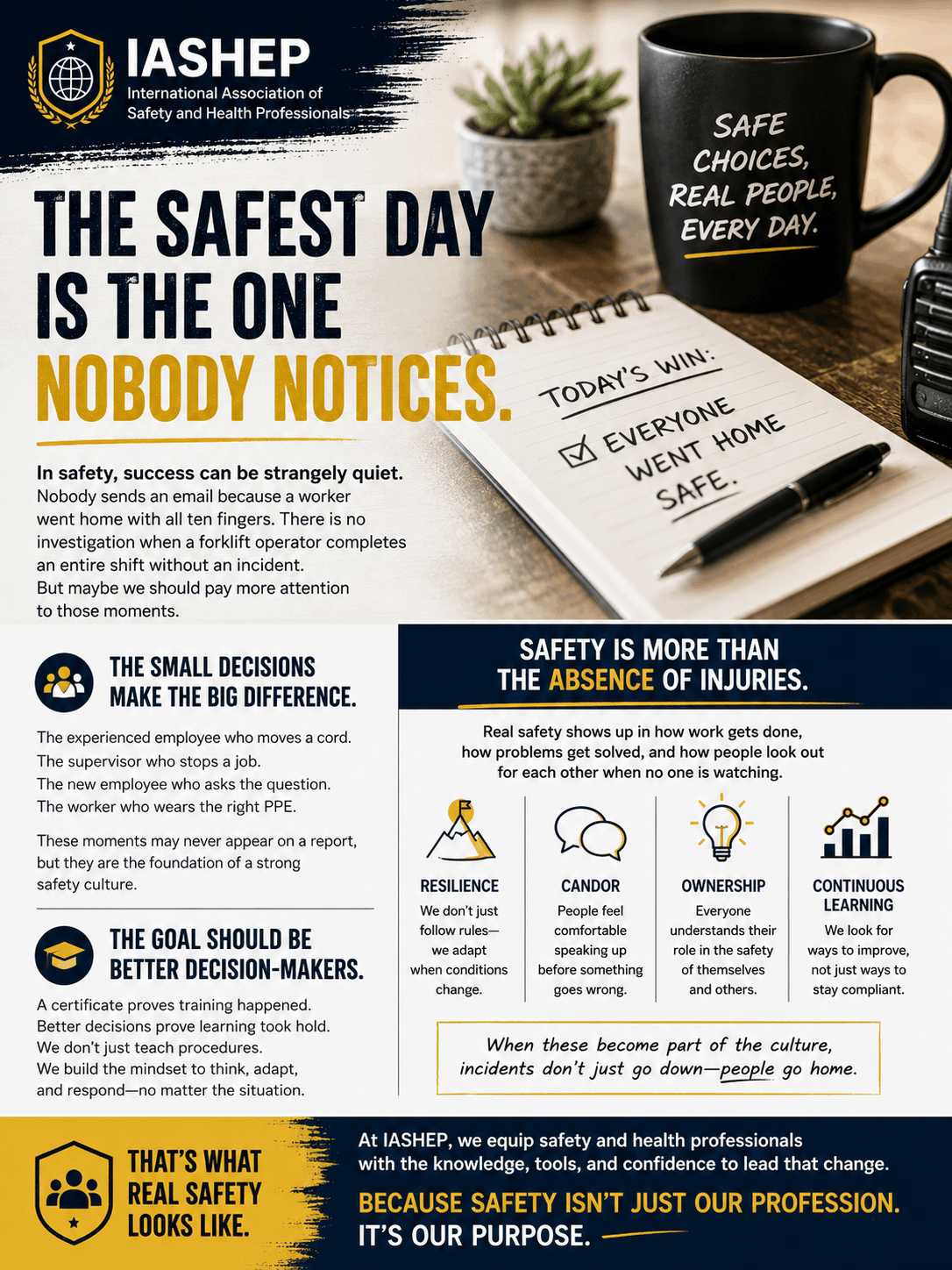
The Safest Day Is the One Nobody Notices
Aug 29, 2026

Obtaining a professional safety certification is an important milestone. It represents dedication, study, practical experience, and a commitment to meeting recognized professional standards. Whether you are beginning your career or advancing into a leadership role, earning a certification demonstrates that you have invested in developing the knowledge necessary to help create safer workplaces.
However, receiving a certificate should never be viewed as the final destination.
Workplaces continue to evolve every day. New technologies are introduced, regulations change, equipment is upgraded, and organizations adopt different processes to improve efficiency. As these changes occur, new workplace hazards emerge while existing risks may require different approaches to control them.
A certification reflects what a professional knew at a specific point in time. Continuing education ensures that knowledge grows alongside the changing demands of modern workplaces.
For safety professionals, lifelong learning is not simply beneficial—it is part of maintaining the ability to protect workers, support compliance, and make informed decisions that affect people's health and well-being.
Why Continuing Education Matters
Safety professionals operate in an environment where change is constant.
Industry regulations are regularly updated. New machinery introduces unfamiliar hazards. Emerging technologies create opportunities while also presenting new risks that require careful evaluation.
Employees also change. Every organization brings together individuals with different experience levels, work habits, and training backgrounds. What worked successfully several years ago may no longer be the most effective approach today.
Continuing education helps professionals stay informed about:
Rather than relying solely on past experience, professionals who continue learning remain prepared to respond to changing workplace conditions with confidence.
Completing Training Is Not the Same as Building Competency
Most safety professionals have attended training sessions that appeared valuable on paper but delivered little practical benefit.
A presentation was given.
An attendance sheet was signed.
A certificate was issued.
Yet only weeks later, much of the information had already been forgotten.
The training was technically completed—but did it actually improve anyone's ability to recognize hazards, reduce risk, or prevent injuries?
That is the question organizations should be asking.
True competency goes beyond completing a course or passing an examination. It focuses on whether an individual can apply knowledge effectively in real workplace situations.
A competent safety professional should be able to:
Identify hazards before incidents occur
Evaluate workplace risks objectively
Recommend practical control measures
Explain safety requirements to employees and leadership
Make informed decisions under pressure
Adapt safety principles to changing situations
These skills cannot be developed through memorization alone.
Opportunities to apply regulations to actual situations
When professionals understand how safety principles apply in everyday operations, they become more confident in making decisions that protect workers while supporting organizational goals.
Training becomes valuable when people leave with skills they can immediately apply—not just information they can remember long enough to pass an exam.
Safety Professionals Carry Significant Responsibility
Few professions influence the health, safety, and well-being of others as directly as occupational safety. Safety professionals are often responsible for making recommendations that affect employees throughout an organization. Their responsibilities include conducting workplace inspections, investigating incidents, identifying hazards, recommending corrective actions, advising management, supporting OSHA compliance initiatives, developing safety policies and procedures, and, when necessary, stopping unsafe work to prevent injuries. They also play a key role in fostering a culture where safety is prioritized at every level of the organization.
In many situations, safety professionals must communicate difficult decisions to supervisors, managers, contractors, and employees while balancing operational demands with worker protection. Simply knowing technical terminology is not enough. They must exercise sound judgment, communicate clearly, evaluate risks objectively, and make decisions that can withstand professional and regulatory scrutiny. These critical skills are strengthened through continued education, practical experience, and an ongoing commitment to lifelong learning.
Experience Alone Is Not Enough
Experience remains one of the greatest teachers.
However, experience without continued learning can become outdated.
A professional may have worked safely for many years while still missing important changes to regulations, technology, or industry best practices.
The strongest safety professionals recognize that learning never truly ends.
They continue to:
Remaining open to learning helps professionals avoid becoming complacent and improves their ability to serve both employers and employees.
Employers Play an Essential Role
Professional development should never rest entirely on individual employees.
Organizations share responsibility for creating an environment where continuous learning is encouraged and supported.
This means selecting training that addresses real workplace hazards instead of choosing programs solely because they are inexpensive or easy to complete.
Employers should also provide opportunities for employees to:
Receive constructive feedback
When learning is connected directly to daily responsibilities, employees are more likely to retain information and apply it effectively.
The benefits extend beyond regulatory compliance.
Organizations often experience:
Continuously strengthen workplace safety practices
When organizations invest in people, they also invest in long-term operational success.
Common Misconceptions About Safety Certification
Many professionals mistakenly believe that earning a certification means their education is complete.
The most effective safety professionals never assume they know everything. They remain curious, continue asking questions, study changes within their profession, and learn from both achievements and challenges.
Most importantly, they recognize that professional development is about far more than career advancement. It is about being prepared when someone's health, safety, or even life depends on the quality of their judgment.
That is why a safety certification should never be viewed as the end of the learning process—it should always be the beginning.
Frequently Asked Questions
Why is continuing education important after earning a safety certification?
Continuing education helps safety professionals stay informed about changing regulations, evolving workplace hazards, new technologies, and current industry best practices, allowing them to make informed decisions that improve workplace safety.
Does experience replace continuing education?
No. While experience provides valuable practical knowledge, regulations, equipment, and workplace risks continue to evolve. Combining experience with ongoing education helps professionals maintain current knowledge and improve decision-making.
What is competency-based safety training?
Competency-based training focuses on an individual's ability to apply knowledge in real workplace situations rather than simply completing a course or passing an examination.
How can employers support continuing education?
Employers can provide access to relevant training, encourage professional development, allow time for learning, promote knowledge sharing, and ensure employees have opportunities to apply new skills in the workplace.
What are the benefits of lifelong learning for safety professionals?
Lifelong learning improves hazard recognition, strengthens leadership, enhances regulatory compliance, supports better decision-making, and contributes to safer workplaces.

Comments (0)
No comments yet. Be the first to comment!
Leave a Comment